Although it feels like I've been throttled, I still need to stick to daily updates
Continuing with the Animal Crossing fruit tree series
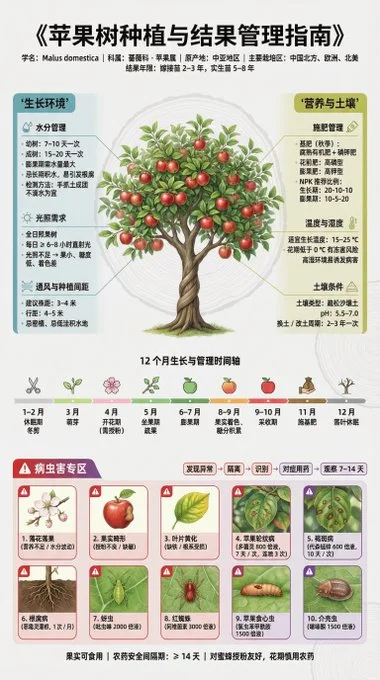
This fruit tree planting guide is perfect for showing to my dad

Nano Banana Pro universal prompt is as follows, 9:16, 2k:
Fruit Tree Planting Science Exhibit Panel | 3:4 Vertical | Museum-Level Information Design
【Main Title】
「×× Fruit Tree Planting and Fruiting Management Guide」
Font: Source Han Sans / Source Han Serif Mix, Ensuring Clear Chinese Rendering

【Subtitle】

Scientific Name · Family and Genus · Origin · Main Cultivation Areas · Fruiting Years
【Central Visual】

Screen Center 25%:
Mature and Healthy Fruit Tree Physical Form (Optional: Potted / Young Tree / Fruiting Branch),
Realistic Natural Museum Specimen Style, Clear Details on Trunk, Leaf Veins, Fruit

Background:
Light Minimalist Base (Off-White / Light Gray)
Subtle Agricultural Geometric Patterns / Fruit Tree Growth Rings / Leaf Vein Structure Texture (Opacity 15–20%)

【Information Layout | Auto-Fill with Real Agricultural Data】

Left Side (Blue-Green Series · Growth Environment)
Water Management
Young Tree / Mature Tree Watering Frequency

Water Needs Differences in Different Growth Stages (Budding / Flowering / Fruit Swelling / Dormancy)
Irrigation Methods (Drip Irrigation / Flood Irrigation)

Soil Moisture Judgment Methods

Light Requirements
Full Sun / Half-Day Sun

Daily Effective Sunlight Duration

Impact Comparison Charts for Insufficient / Excessive Light

Ventilation and Spacing

Row and Plant Spacing Recommendations

Avoid Dense Planting, Avoid Waterlogged Low-Lying Environments

Right Side (Yellow-Green Series · Nutrition and Soil)

Fertilization Management

Base Fertilizer / Top Dressing / Pre-Flower Fertilizer / Post-Fruit Fertilizer

NPK Ratio Pie Charts (Different Periods)

Fertilization Frequency and Taboos (Avoid Root Burn)

Temperature and Humidity

Four-Season Growth Temperature Curve

Flowering Low-Temperature Risk Alerts

Schematic of Diseases Caused by Excessive Humidity

Soil Conditions

Soil Types (Sandy Loam / Humus Soil)

pH Range

Soil Amendment Plans (Organic Matter / Lime / Sulfur Powder)

【Middle Horizontal Bar】

12-Month Fruit Tree Growth and Management Timeline

Pruning Period

Budding Period

Flowering and Pollination Period

Fruit Setting Period

Fruit Swelling Period

Harvest Period

Dormancy Period
(Iconized Presentation)

【Bottom Pest and Disease Section | 30% Area | Red-Purple Warning Colors】

10 Common Fruit Tree Pest and Disease Identification Cards (3-Row Grid)

Physiological Issues

Flower and Fruit Drop (Nutrition / Temperature / Moisture)

Fruit Deformity (Poor Pollination / Boron Deficiency)

Leaf Yellowing (Iron Deficiency / Nitrogen Deficiency / Root Issues)

Fungal Diseases
4. Anthracnose
5. Brown Spot Disease
6. Root Rot Disease
Pests
7. Aphids
8. Red Spider Mites
9. Fruit Flies
10. Scale Insects

Each Card Includes:
Symptom Close-Up Image (40%)

Identification Key Points

Specific Control Measures

Pesticide Name + Dilution Ratio + Application Frequency
Example:
Mancozeb 600x Solution, Once Every 7 Days, Spray 2–3 Times Consecutively

Emergency Handling Flowchart
Discovery → Isolation → Assessment → Targeted Treatment → Continuous Monitoring

【Bottom Information Bar】
Fruit Edibility Notes
Pesticide Safety Interval Periods
Safety Alerts for Bees / Pets / Humans

【Design Specifications】
Information Density: High (White Space ~25%)
Connection Lines: Radiating Outward from Fruit Tree, Ultra-Fine Lines
Color Coding:
Blue = Moisture
Yellow = Light
Green = Nutrition
Red = Diseases
Purple = Pests
Font Hierarchy:
Main Title 16pt
Body Text 12pt
Notes 9pt

Icons: Unified Linear Agricultural Science Style

Chinese Typography: Line Spacing 1.5, Compact and Readable

Disease Cards: Red Borders + Symptom Magnified Images

【Style References】

Japanese Fruit Tree Experiment Station Guide Signs

Modern Natural History Museum Agricultural Info Walls
DK《Fruit Tree Cultivation Atlas》

【Technical Parameters】
Frontal View / Slight Overhead View
Soft Natural Light
Medium to Large Depth of Field
4K Ultra High Definition
Real Agricultural and Horticultural Photography-Level Details

【Key Requirements (Very Important)】

All planting data, pest and disease information, pesticide names and usage concentrations must be automatically filled with real, accurate, verifiable professional agricultural data based on the selected fruit tree variety

English Supplement (Image Generation Weight)

fruit tree cultivation guide poster, high-density agricultural infographic,
museum exhibition style, fruit tree growth cycle, pest and disease identification,
Chinese typography, minimalist background, professional horticulture data,
realistic fruit tree specimen, 4K ultra high resolution